This ‘Friday Night at the Movies’ is ‘Spectre’, followed by ‘Bill’ at the Children’s Cinema Club’ on Saturday. See poster below for details:

This ‘Friday Night at the Movies’ is ‘Spectre’, followed by ‘Bill’ at the Children’s Cinema Club’ on Saturday. See poster below for details:
This ‘Friday Night at the Movies’ is ‘The Martian’, followed by ‘Inside Out’ at the Children’s Cinema Club’ on Saturday. See poster below for details:

The next Parish Council Meeting will take place at 7.30 on Thursday February 11th in the Old School Room. The meeting is open to the public, and if anyone wishes to address the Council on any of the items on the agenda, please notify David Marriott on 0787 2930030 or horleyparishclerk@btinternet.com before the meeting. Whilst there is no absolute right to do this, the Chairman has the authority to permit it if he chooses to do so.
The Agenda Items include:
For full details of items and reports see 16 02 11 agenda
 Mike is to be awarded Oxfordshire’s High Sheriff Award in recognition of his significant and lasting contribution to community life in Horley and with schools in the local area.
The High Sheriff of Oxfordshire issues awards each year to people who have made a difference to their community over many years, and whose contribution has not been recognised in some other formal way.
The Parish Council put Mike’s name forward for this award for his valuable work over the years. Some of the many activities and projects includes:
The office of High Sheriff is a ceremonial role involving a mix of charitable and community functions. It is the oldest secular office in the country outside of the monarchy but without the extensive powers it used to have. It is unfunded, voluntary and non political. The current High Sheriff 2015/16 is Tom Birch Reynardson. There will be a formal award ceremony in Oxford on 29 February which Mike will attend.
Congratulations Mike, very well deserved and thank you for all your efforts over the years; it is very much appreciated. We hope you will share your pictures of the ceremony and what this award means to you and Sue.
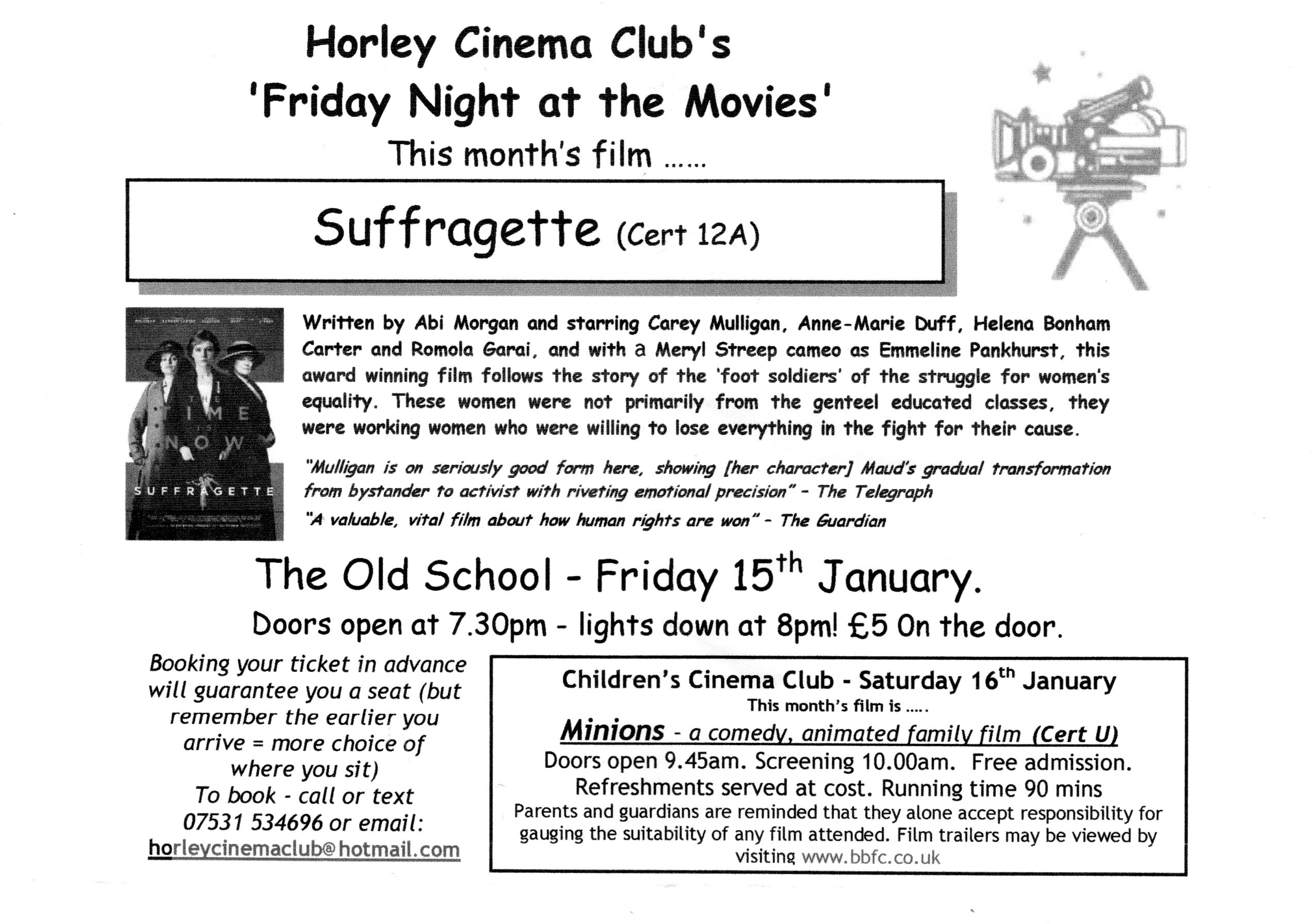
Happy New Year from Horley Cinema Club. Our first movie for 2016 is Suffragette on Friday 15th at 7:30, see the flyer below. Also note Minions for the the children’s club showing on the Saturday 16th at 9:45.
Monday 11th Back to Play –
 Come join a ‘run by mums’ playgroup on Mondays 10-12 in the Horley School hall, its held during term time on Mondays from 10 to 11.45. Only £1.50 for the first child, additional children are 50p, and you only pay for children over 12 months. Contact – Natalie King 07852218815 or Email Nataliepoo79@hotmail.com for more information, or just come along.
Changes in Health provision –Robert Pearson writes about his sister Joan’s admission from The School House to hospital in the early 1920s with scarlet fever:
‘Even some of the ambulances were still horse driven in those days. A very early, traumatic experience was when Joan was perhaps five or six years of age. She was diagnosed as having scarlet fever, then a much feared disease, passed on by direct contact with somebody who already had it. Presumably, in this case, from another child in my mother’s school. It involved going into an isolation hospital on the outskirts of Banbury. I remember so well this ambulance turning up late one afternoon shortly before it got dark – so it must have been in autumn, a time of the year when this disease was most likely to strike – and Joan being driven away. It was a Dickensian scene. The driver sat outside the cab on a high seat (presumably so that he would not be contaminated), and this made the scene somewhat macabre. Consequently she was all alone for the four-mile journey into hospital. When we went to see her the next day, and on subsequent visits, we were only allowed to see into her ward through a window. It left one with a feeling of great anxiety. However, all was well and she was home again after a few weeks. In those days this infection was considered very serious, and could in the worst cases lead to death. Now one never seems to hear of it – another disease brought fully under control.’
My own early childhood in the first half of the 1940s was free of any vaccinations except a smallpox vaccine as a baby. My sisters and the rest of Horley’s child population suffered spotty bodies, fevers, vomiting, sore throats, pains in the eyes, and headaches that came as a result of measles, German measles (rubella), mumps, chicken pox and whooping cough (pertusis) as they swept round the village. Although unwelcome there were mantras murmured by tired parents that at least the illnesses were over and that the younger the child, the quicker the recovery.
The most dreaded infection was polio where there were high rates of permanent disability or death. We saw the effect on Modesta Collar who from her teenage years had to walk with a stick. In the early 1950s Peggy Ann, the little daughter of Minnie Shawyer, died of infantile paralysis as it was also known. Epidemics of the other illnesses sometimes left tragedy in their wake too, and slightly before our time a young girl in Hornton had died of diphtheria – so there was always some anxiety about the outcome.
So we stoically endured these childhood illnesses as if they were rites of passage. Strictly speaking they were not childhood illnesses. Adults were not immune from them and the impact could be far more severe. My parents’ generation could only be protected from Smallpox. My mother had two wheals on her upper arm: large oval imprints with about six needle marks in each to commemorate her inoculation as a child against this deadly disease, now almost forgotten.
However, remarkable improvements in preventive medicine were afoot – something that made life much safer for all of us. A diphtheria, tetanus and measles vaccination was introduced in the late 1940s while I was in Horley School and was administered to us by the school doctor, Dr Ann Davies and Nurse Prescott. The needles were large and extremely painful and we nursed swollen arms for a week or more. By the late 1950s BCG for Tuberculosis (TB) was introduced – administered on a cube of sugar. Shân and Honor my younger sisters both had this advantage, but teenagers of my age and older were excluded from the programme. Shân further benefitted from advances in medical knowledge and experimental surgery, saving her from the life-threatening condition myasthenia gravis.
 Entertaining – In the 1940s Horley’s polite society invited each other to tea. This could be modest: Barry Dunwoody remembers going with his grandmother Mrs Jelfs to have tea with Mrs Chapman and Miss Chapman at Park House where they always had tea and arrowroot biscuits.
The rules of Afternoon Tea were ritualistic. Arrival at 3.30pm in best clothes, gentle non-controversial conversation, the best (sometimes hand-embroidered) white linen tablecloth with sharply ironed fold marks and a crocheted edge, with the best china. Then either biscuits, or in affluent homes a plate of buttered bread cut extremely thinly from a loaf that had to be several days old to acquire the right refined thinness, jam in a special glass pot with its own jam spoon, and a single layer of Victoria sponge cake cut through and smeared with raspberry jam, and occasionally jam tarts.
Everyone sat upright hands in laps, no elbows on the table, small napkin on lap, bread and cake cut into small morsels and not bitten off in chunks. Children generally waited to be spoken to, and everybody waited to be offered food. It was not polite to complain about discomfort, so when Barry Dunwoody wearing short trousers had to sit on Mrs Chapman’s chair which had a seat stuffed with horse hair, he had to suffer the prickliness on his legs in silence.
One of the social niceties I found difficult to acquire was when to decline invitations to another piece of cake, when I would have liked it, and what words to use. It was at odds with the principle of always telling the truth in life. My mother also asked us not to use the words ‘I’m full up’, nor the grandiloquent ‘I have had an adequate/elegant sufficiency’. I learned to say ‘No, thank you very much’, which was a lie. It was all very difficult for a child.
The mid 1950s saw the last days of the afternoon tea ritual. Coffee and homemade cake at eleven in the morning took over – it was informal, quicker, could be fitted in after cleaning and before lunch, required less preparation, and the complications of tablecloths and napkins and sitting round a table were abandoned.
The other joy was the introduction of alcohol into our lives: sherry parties on Boxing Day, and soon sherry parties to celebrate anything. Then in the late 50s we graduated to something approaching the cocktail parties we read about in the magazines – well, not quite, not the cocktails themselves, but these were the hey-days of pearl onions, and tinned pineapple chunks with cubes of cheddar cheese speared on cocktail sticks and stuck into a grapefruit. It was all new, exciting and terribly sophisticated!
The range of food expanded beyond our dreams. Not only did bananas enter our diet after the war, but stranger things – in the early 1960s Shân Morgan, my sister bought one very expensive avocado from The Greengrocer in Warwick Road. It was hard but we were determined to like it. At the end of the 1950s it was noised abroad that a Chinese restaurant had opened in Stratford, and not long afterwards there was one in Banbury, and we self-consciously tried chopsticks. My first struggle with real spaghetti bolognese was in Oxford about the same time; and my first curry in Tiger Bay in the early 1960s. I and the rest of the UK have never looked back.
Walks – Sunday afternoons after Sunday School was a time when families who had not fallen asleep after the Sunday roast would take a walk along the roads out of the village, joining up with each other and taking time to have leisurely conversations. In urban or seaside places it might have been called promenading. It was more strolling than power-walking: parents chatting and children and dogs dashing off into the hedgerows and fields.
Until the early 1960s there was still a tradition that Sunday was a day of rest, and so Jim Eadon of Chapel Cottage who never darkened the doorway of either church or chapel, was deeply offended that his neighbour Theo Peake of Hillside Farm had a modern suburban habit of motor-mowing his lawn on Sunday afternoon.
Saturday night was by custom bath night. On Sunday people discarded their work clothes, cleaned their shoes, and wore their best clothes to go to services.
For a number of families the day was ordered by the times of the church and chapel services, and this was signalled by the church bells so the whole village knew. On a still day this was reiterated by the sound of Drayton’s bells drifting across the fields. Although there were always animals that needed attention, farmers did not plough or even harvest on Sunday unless it was urgent – partly because the labour was not available.
But this was a time of change: young bellringers left the village and the bells ceased to ring. The seven-day imperatives of the food market and the efficient use of expensive farm machines prevailed. As more people bought motorbikes and cars, Sunday the day of rest was spent away from the village.
On weekday afternoons mothers with prams or push chairs might take a brisk walk before other children came home from school. No parents ever walked to the school to meet their child – there was not the time to do so, and it was not the custom.
Coming up in the 3rd and final part:
Clare Marchant, June 2015
 The is an extract from A Vanished Past Volume 1, each Volume is £15 +P&P or you can buy both for £33 incl. p&p.
They are available directly from Clare , Shaftesbury House, 15 Circus Street, Greenwich, London SE10 8SN or marchantclare@hotmail or call on 020 8858 8529. Cheques payable to Clare Marchant.
Clare Marchant was born in Horley Vicarage, Oxfordshire in 1941 and spent her formative years there until 1965. She now lives in Greenwich, London
First published in 2015. All rights reserved. The rights of Clare Marchant to be identified as author of this work has been asserted in accordance with the Copyright, Design and Patents Act 1988. No part of this publication may be reproduced without the consent of © Clare Marchant. Copyright for each image rests with the contributor.
This Friday (20th) night at the movies is Mr. Holmes, followed by the Saturday (21st) Children’s Club is Into the Woods, see poster for details:
Have you noticed the yellow box outside the Red Lion?

The new defibrillator outside the Red Lion
It’s our new Automated External Defibrillator (AED) that has recently been installed on the wall outside the Red Lion (soon to be commissioned ). This is expected to happen within the next few days – as soon as the white notice disappears then the machine is fully functioning so keep an eye out.
For more information on your new AED and how to take part in a specially arranged training session on Wednesday November 18th see below and information on the Parish Notice Board.
This potentially lifesaving device has been procured by the Parish Council from the Community Heartbeat Trust, and has been installed on the front wall of the Red Lion close to the telephone box. It will become available for use in the next few days, as soon as it is registered with the ambulance service.
A defibrillator (AED) is used in cases of cardiac arrest or arrhythmia, when swift action can make all the difference to a patient’s chances of survival. If you or someone you are with appears to be suffering from a cardiac condition, the first thing to do is always to ring 999. If it appears that the use of a defibrillator is called for, the operator will be able to direct you to the Horley AED, and will be able to supply the secure access code to open the locked cabinet door. The AED contains simple instructions and is fully automated, so it will not operate unless it detects an irregular heartbeat.
Whilst the AED can be used without any training, the Parish Council has arranged for Community Heartbeat to provide a session which anyone in the village is welcome to attend. This will cover how and when the AED should be used, together with other resuscitation techniques and related issues. The training will take place at the Old School at 7.30 pm on Wednesday 18 November. Anyone intending to attend the session is asked to notify the Clerk to the Parish Council, David Marriott, in advance, by emailing him at horleyparishclerk@btinternet.com, or by calling him on 07872 930030.
The next Parish Council Meeting will take place at 7.30 on Thursday November 12th in the Old School Room. The meeting is open to the public, and if anyone wishes to address the Council on any of the items on the agenda, please notify David Marriott on 07872930030 or horleyparishclerk@btinternet.com before the meeting. Whilst here is no absolute right to do this, the Chairman has the authority to permit it if he chooses to do so.
The Agenda Items include:
For full details of items and reports see 15 11 12 agenda
 TheHorleyViews.com